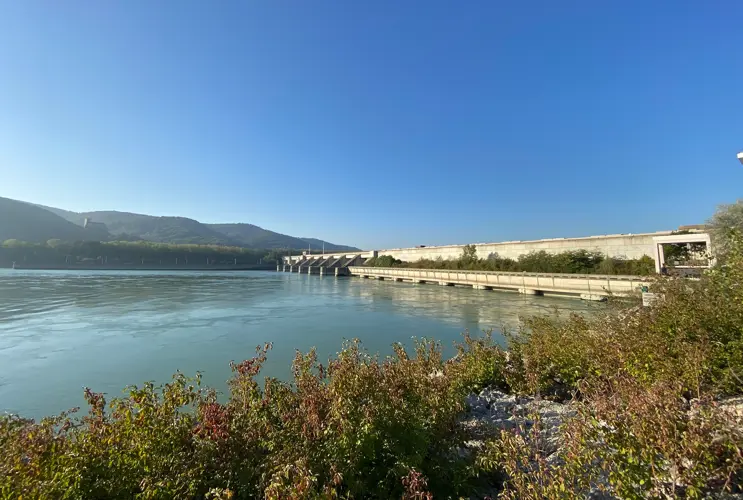
Danube power plants
Measuring around 2,850 kilometres in length, the Danube is the second-longest river in Europe after the Volga River and flows through a total of 10 countries, more than any other river in the world. It rises in the Black Forest in Germany and flows into the Black Sea in the Danube Delta in Romania.
The Danube plays an important role in trade and shipping in Central Europe as it links major cities including Vienna, Budapest and Belgrade. The river is also known for its biodiversity, especially in the Danube Delta, which is a UNESCO World Heritage Site and home to a variety of bird species and abundant flora and fauna.
Power plants on the Danube and floods
Flooding of the Danube in 2013

Due to heavy rainfall along the entire northern edge of the Alps, a once-in-a-century flood wave surged through the Danube valley, causing enormous damage. The Eferding Basin, which has no flood protection, was affected by a flood of a magnitude that statistically occurs only once every 250 years. The volume of water was even more than in the “flood of the century” in 1954. However, the peak water levels of 1954 were not reached.
During flood events, Danube power plants have no capacity for retention. Where possible, power plants control the water levels in accordance with government-defined regulations, the Weir Operating Regulations. The main aim is to protect the dams and the people who live behind them.
Investigations and analyses
In the official flood report, the highest water authority confirms that VERBUND employees did everything possible during the flood to minimise damage.
The Ministry of the Environment, together with the hydrographic departments of the federal states, presented a detailed analysis of the June 2013 flood. In addition to official data on the event, comparisons were also made with previous catastrophic floods.
Previous floods on the Danube

In July 1954, a catastrophic Danube flood shook postwar Austria, which was still occupied at that time. Aid shipments from all over Europe alleviated the worst of the crisis. The media of the time described immense devastation, especially in Upper Austria. The Oberösterreichische Nachrichten lamented the loss of “50,000 hectares of fertile soil”. Farmland became a “sea of mud”, wrote the Arbeiter-Zeitung, and the Linzer Volksblatt reported a “sand desert between Eferding and Danube”.
Oberösterreichische Nachrichten, 12 July 1954PDF / 401.4 KB
Arbeiter-Zeitung, 21 July 1954PDF / 931.8 KB
Linzer Volksblatt, 21 July 1954PDF / 784.5 KB
Technical discussions were dominated by considerations regarding how power plant construction should relate to flooding on the Danube River. In the section “Planning, history and principles of Danube power plants”, author Kurt Liewehr explains: “Therefore, in its construction projects, Donaukraftwerke AG is not allowed to protect flood plains. On the contrary, it must [sic] pay particular attention to preserving these retention areas, which are of utmost importance for the storage and retention of flood masses and for mitigating flood peaks”.

Contact
Do you have any questions about electricity generation on the Danube? Our PR team is here to help you.

Florian Seidl
Spokesperson Region East